
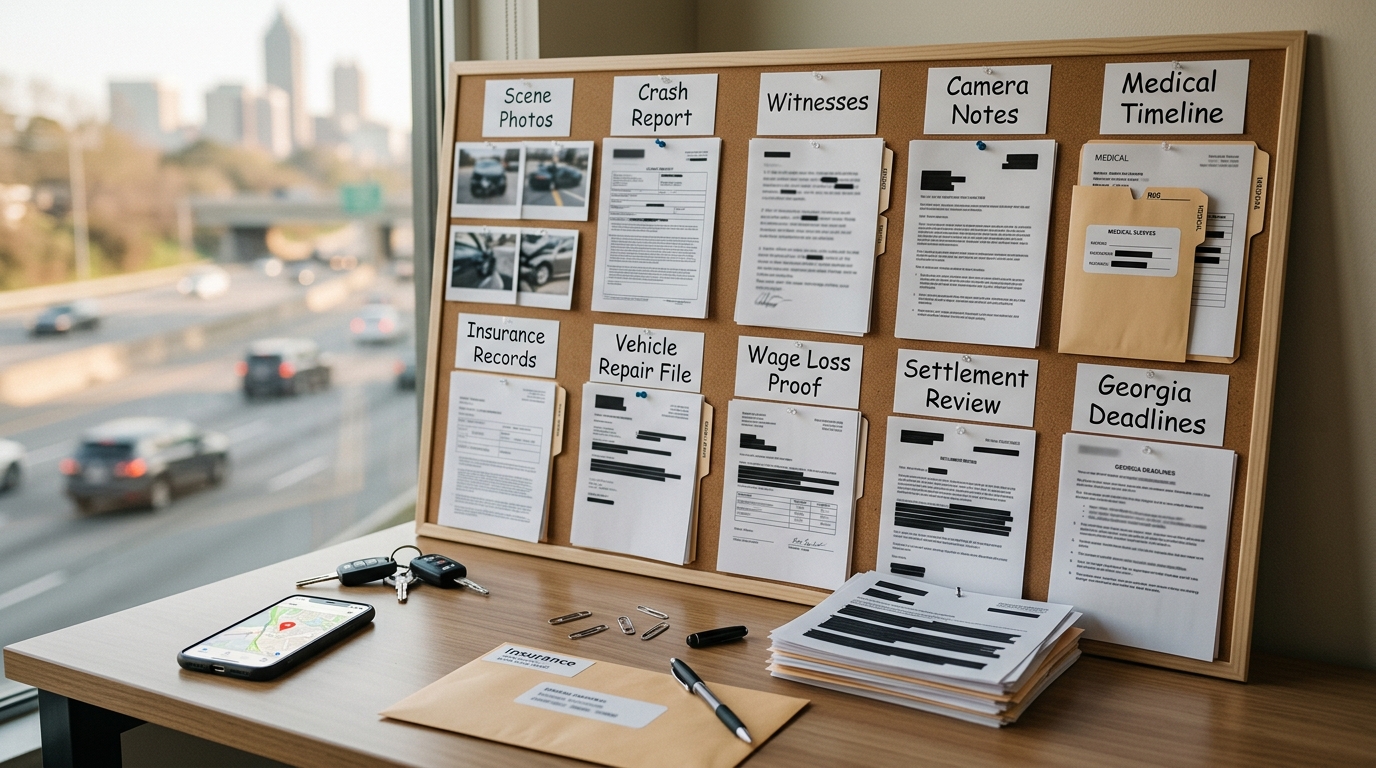
A personal injury claim is stronger when the records tell the same story from different angles.
After an accident in Atlanta, an insurance company may review where the injury happened, who was responsible, whether the incident was officially documented, when medical symptoms appeared, how treatment progressed, what bills were created, whether work was missed, what coverage applies, and whether any statement conflicts with the claim.
That is why evidence should not be treated as one pile of paperwork. It should be organized like a control room, with each station answering a different question.
This guide explains what evidence strengthens a personal injury claim in Atlanta, how to preserve records before they disappear, and why Georgia deadlines and fault rules make early documentation important.
Quick Answer
Evidence that strengthens a personal injury claim includes scene photos, videos, crash reports, incident reports, witness contact information, nearby camera notes, medical records, medical bills, treatment timelines, repair estimates, rental receipts, wage-loss proof, insurance letters, policy documents, settlement offers, and a written record of how the injury affected daily life.
If you were injured in Atlanta and need help identifying, preserving, or organizing evidence, speaking with a personal injury lawyer in atlanta georgia may help you understand which records matter most. You can also use the Thompson Law Atlanta profile as a local starting point for map access, profile details, and contact options.
Key Takeaways
- Strong injury claims usually rely on multiple evidence categories, not one document.
- Photos, videos, official reports, witness names, and camera notes help show what happened before the scene changes.
- Medical records, bills, imaging, referrals, and treatment timelines help connect the accident to the injury.
- Repair records, rental receipts, wage proof, and out-of-pocket receipts help document financial impact.
- Insurance letters, claim logs, coverage documents, and settlement papers should be saved.
- Georgia deadlines, public-entity notice rules, and comparative-fault issues make early evidence preservation important.
The Atlanta Evidence Control Room
Think of your claim as a control room with separate evidence stations.
| Evidence Station | Main Question It Answers |
| Scene Station | What did the location, vehicles, hazard, or roadway look like? |
| Report Station | Was the incident officially documented? |
| Witness Station | Can someone confirm what happened? |
| Camera Station | Was the incident captured before footage disappeared? |
| Medical Station | What injuries followed the accident? |
| Treatment Timeline Station | Did care follow a clear sequence? |
| Damage and Expense Station | What financial losses resulted? |
| Insurance Station | What did the insurers say, request, deny, or offer? |
| Deadline Station | What Georgia timing issues could affect the claim? |
A claim becomes stronger when the stations support one another. A crash report is useful. A crash report plus photos, medical records, witness names, repair documents, and a treatment timeline is stronger.
Station 1: Scene Photos and Videos
Scene evidence often disappears first. Vehicles move, hazards are cleaned up, debris is cleared, lighting changes, traffic patterns shift, and witnesses leave.
If safe, photograph or record:
- Vehicle damage
- License plates
- Final vehicle positions
- Road layout
- Lane markings
- Traffic signs
- Traffic signals
- Crosswalks
- Skid marks
- Debris
- Paint transfer
- Broken glass
- Weather conditions
- Lighting conditions
- Construction zones
- Nearby businesses
- Nearby cameras
- Visible injuries
- Damaged personal property
For non-crash injuries, photograph:
- Wet floors
- Broken pavement
- Poor lighting
- Missing handrails
- Damaged stairs
- Loose mats or rugs
- Spills
- Store aisles
- Parking-lot hazards
- Apartment walkways
- Hotel or restaurant conditions
- Warning signs or missing warnings
Take wide photos and close-up photos. Wide photos show context. Close-ups show details. Do not put yourself in danger to gather evidence. Safety comes first.
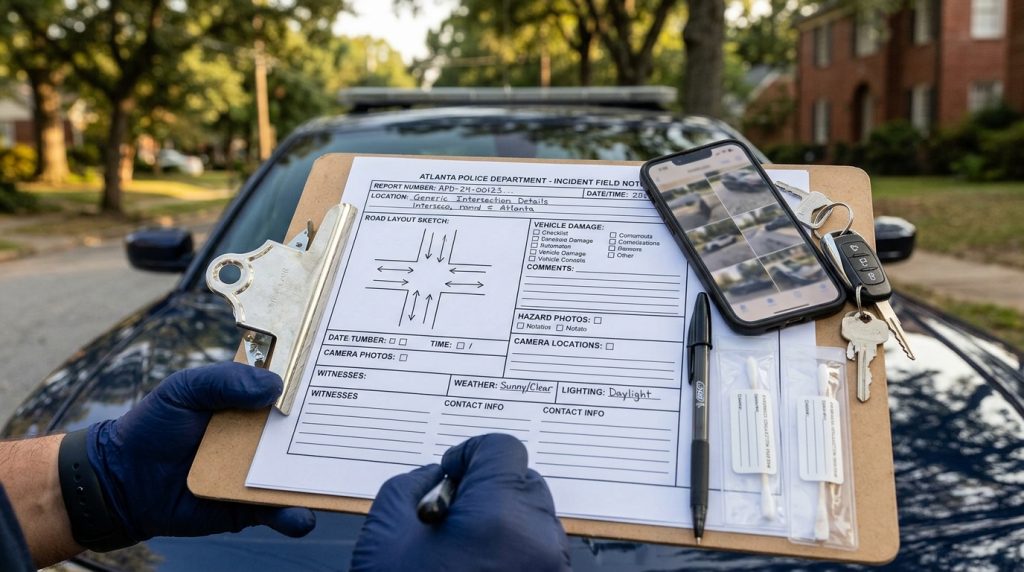
Station 2: Crash Reports and Incident Reports
Official reports help create a dated record of the event.
For Atlanta car accidents, the Georgia Motor Vehicle Crash Report, also known as GDOT-523, is the official document Georgia law enforcement agencies use to collect and share crash data.
A crash report may help document:
- Accident date
- Accident time
- Crash location
- Drivers
- Vehicles
- Insurance information
- Reported injuries
- Witnesses
- Citations
- Contributing factors
- Officer observations
- Report number
The Atlanta Police Department’s Central Records Unit is the main repository for reports created by Atlanta police officers, and APD says accident reports may also be purchased online through BuyCrash.
For unsafe property injuries, ask whether the business, apartment complex, hotel, restaurant, office building, parking garage, event venue, or property manager created an incident report.
If you cannot get a copy immediately, write down:
- Who took the report
- When the report was made
- What agency, business, or property was involved
- Report number, if available
- Names of people who spoke with you
- Whether photos or video were mentioned
- How to request the report later
A report helps, but it is not the whole claim. Reports may omit details, miss witnesses, or describe injuries before symptoms fully develop.
Station 3: Witness Information
Witnesses can become important when fault is disputed.
Ask witnesses for:
- Name
- Phone number
- Email address
- Where they were located
- What they saw
- Whether they took photos or video
- Whether they are willing to be contacted later
Witnesses may include:
- Other drivers
- Passengers
- Pedestrians
- Cyclists
- Store employees
- Restaurant workers
- Apartment staff
- Hotel employees
- Security guards
- Parking attendants
- Rideshare passengers
- Delivery drivers
- Nearby residents
Do not argue with witnesses or pressure them. The goal is to preserve contact information while memories are fresh.
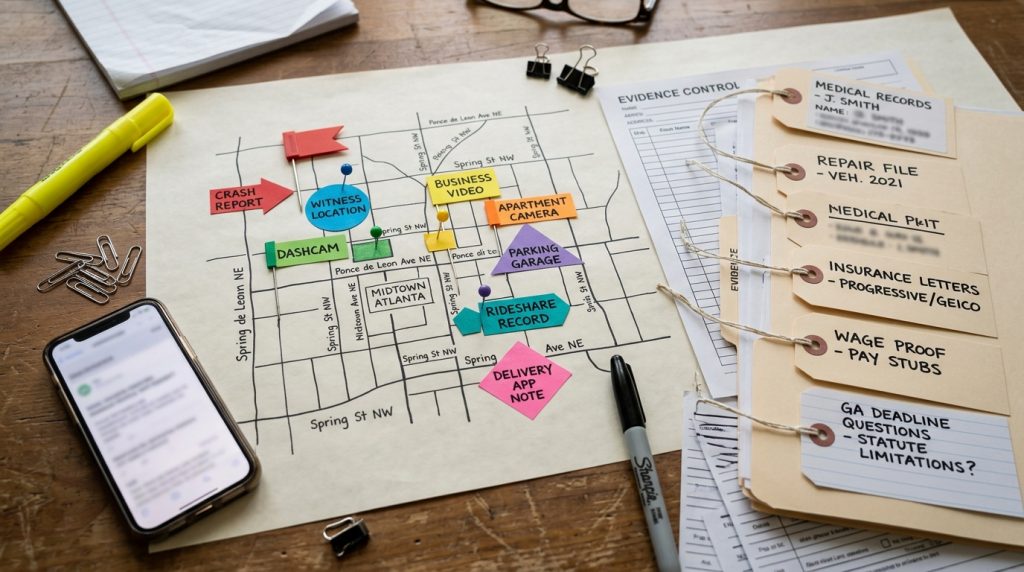
Station 4: Camera and Digital Evidence
Camera evidence can strengthen a claim, but it is often time-sensitive.
Possible camera sources include:
- Dashcams
- Doorbell cameras
- Business cameras
- Gas station cameras
- Restaurant cameras
- Hotel cameras
- Apartment entrance cameras
- Parking garage cameras
- Retail store cameras
- Security gate cameras
- Rideshare app records
- Delivery app screenshots
- Commercial vehicle cameras
- Truck electronic logging or telematics data
- Phone photos and videos
- GPS records
- Tow records
- Repair intake photos
Write down the camera location, business name, address, camera direction, and approximate incident time. Do not assume footage will be saved automatically.
Camera notes may be especially useful after accidents near I-75, I-85, I-20, I-285, GA-400, the Downtown Connector, Midtown, Downtown, Buckhead, West Midtown, Old Fourth Ward, Hartsfield-Jackson airport routes, MARTA-adjacent streets, campus corridors, hospital areas, parking garages, hotels, retail centers, apartments, restaurants, and delivery corridors.
Station 5: Medical Records and Bills
Medical evidence is one of the most important parts of a personal injury claim.
Medical records may show:
- When symptoms were first reported
- What symptoms were reported
- What diagnosis was made
- What treatment was recommended
- Whether imaging was ordered
- Whether referrals were made
- Whether work restrictions were given
- Whether follow-up care was needed
- Whether future treatment may be necessary
- Whether the record connects the injury to the accident
Save records from:
- Emergency medical services
- Emergency rooms
- Urgent care clinics
- Primary care doctors
- Orthopedic specialists
- Neurologists
- Imaging centers
- Physical therapy providers
- Pharmacies
- Pain management providers
- Rehabilitation providers
- Mental health providers, if accident-related trauma is treated
Also save:
- Discharge instructions
- Imaging reports
- Medical bills
- Prescription receipts
- Referral paperwork
- Work restriction notes
- Therapy attendance records
- Follow-up appointment summaries
Insurance companies may review medical timing closely. Delayed care, missed appointments, unclear symptoms, or incomplete records can lead to disputes.
Station 6: Treatment Timeline
Medical records are easier to understand when they are organized into a timeline.
Create a simple timeline with:
- Accident date
- First symptoms
- First medical visit
- Emergency care
- Urgent care
- Primary care follow-up
- Imaging
- Specialist visits
- Therapy start date
- Missed appointments, if any
- Work restrictions
- Symptom changes
- Future-care recommendations
A treatment timeline helps show how the injury developed. It can also explain why symptoms worsened, why additional care was recommended, and how treatment followed the incident.
Station 7: Repair, Rental, and Property Damage Records
For car accident claims, vehicle damage records may support both property damage and injury arguments.
Save:
- Vehicle damage photos
- Repair estimates
- Supplemental repair estimates
- Body shop invoices
- Total-loss valuation paperwork
- Rental car receipts
- Towing receipts
- Storage bills
- Photos of damaged personal property
- Child seat replacement documentation, if relevant
- Communications with repair shops
- Communications with insurers
Insurance companies may compare injury claims to vehicle damage. They may argue that low visible damage means the injury should be minor. Detailed repair records, hidden-damage estimates, photographs, and medical records can help respond to those arguments.
For premises cases, save proof of the property condition, incident report, witness names, camera locations, receipts showing you were there, and any communication from the property owner or insurer.
Station 8: Wage Loss and Financial Impact
An injury claim may include financial losses beyond medical bills and repairs.
Save:
- Pay stubs
- Timesheets
- Employer letters
- Missed-shift confirmations
- Work restriction notes
- Tax records
- Contractor invoices
- Business income records
- Proof of used sick time or vacation time
- Reduced-duty notes
- Medical travel receipts
- Parking receipts for medical visits
- Medical equipment receipts
- Childcare receipts related to appointments
- Receipts for help at home
If the injury affects future earning ability, additional records may be needed. That may include job descriptions, income history, medical restrictions, employer statements, and documentation showing how the injury limits work duties.
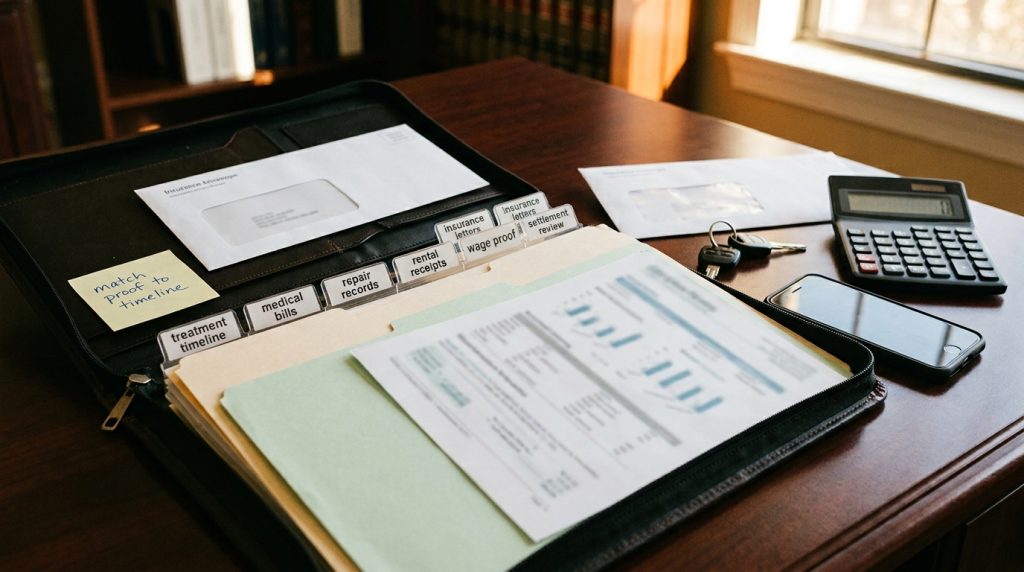
Station 9: Insurance Letters and Claim Logs
Insurance communication can become confusing. Keep every claim-related document.
Save:
- Claim numbers
- Adjuster names
- Insurance company names
- Phone numbers
- Email addresses
- Coverage letters
- Denial letters
- Payment explanations
- Recorded statement requests
- Medical authorization requests
- Settlement offers
- Repair decisions
- Rental decisions
- Policy declarations pages
- Emails and letters
- Notes from phone calls
Keep a claim log with the date, time, person you spoke with, and what was discussed.
Georgia insurance claim tips recommend keeping a record of time and expenses and providing records to the claims adjuster. Georgia auto claim tips also advise drivers not to make oral or written statements about responsibility or blame after an accident.
That is why your insurance file should be factual, organized, and complete.
Station 10: Daily-Life Impact Records
Some losses do not appear clearly on a bill.
A recovery journal may help document:
- Pain levels
- Sleep problems
- Headaches
- Mobility limits
- Anxiety while driving
- Missed family activities
- Missed school events
- Household tasks you cannot do
- Difficulty lifting, bending, walking, or sitting
- Medication side effects
- Transportation problems
- Changes in childcare responsibilities
- Emotional stress
- Activities you stopped doing
Keep the journal factual. Short, dated notes are usually better than dramatic summaries written months later.
Match the Atlanta Accident Setting to the Evidence
The type and location of the accident can shape the evidence you need.
Freeways, Interchanges, and High-Speed Roads
Crashes on I-75, I-85, I-20, I-285, GA-400, the Downtown Connector, and major ramps may involve high speeds, merging, sudden stops, lane changes, commercial vehicles, or multi-vehicle impacts.
Helpful evidence may include:
- Crash report
- Dashcam footage
- Vehicle resting-position photos
- Tow records
- Exit and ramp details
- Witness information
- Repair estimates
- Medical records
Downtown, Midtown, Buckhead, Airport, and Event-Area Crashes
Dense areas may involve pedestrians, rideshare vehicles, delivery drivers, buses, scooters, parking garages, hotels, valet areas, airport shuttles, and business cameras.
Helpful evidence may include:
- Crosswalk photos
- Signal photos
- Business camera notes
- Parking garage details
- Rideshare receipts
- Witness names
- Medical records
- Police report information
Parking Lots, Apartments, Stores, and Restaurants
Parking-lot and property-adjacent injuries may involve backing vehicles, poor lighting, spills, broken pavement, missing warnings, or unclear right-of-way.
Helpful evidence may include:
- Incident report
- Vehicle-position photos
- Hazard photos
- Store or apartment camera notes
- Receipts showing you were there
- Witness information
- Medical records
Truck, Delivery, and Commercial Vehicle Accidents
Commercial vehicle claims may involve company records beyond the crash report.
Helpful evidence may include:
- Company name
- Vehicle markings
- USDOT number, if visible
- Trailer number, if any
- Driver information
- Dispatch clues
- Delivery records
- Maintenance records
- Electronic data
- Crash report
- Medical records
- Insurance letters
Unsafe Property Injuries
If the injury happened on someone else’s property, the evidence may focus on the hazard.
Helpful evidence may include:
- Hazard photos
- Incident report
- Camera locations
- Witness names
- Lighting conditions
- Warning signs
- Cleaning or maintenance clues
- Weather conditions
- Property manager information
- Medical records
What Evidence Insurers Often Challenge
Insurance companies may challenge evidence in several ways.
They may argue:
- Photos do not show the whole scene.
- A crash report is incomplete or unfavorable.
- Witnesses are missing.
- Medical treatment was delayed.
- Treatment had gaps.
- Medical bills are too high.
- Injuries were pre-existing.
- Vehicle damage was minor.
- The injured person was partly at fault.
- Statements were inconsistent.
- The claim lacks proof of lost wages.
- The claim lacks proof of future care.
- The settlement demand exceeds available coverage.
- A release was already signed.
A strong evidence control room anticipates these arguments and answers them with records.
What Can Weaken a Personal Injury Claim?
Some mistakes can weaken an otherwise valid claim.
Avoid:
- Waiting too long to seek medical care
- Missing appointments without explanation
- Failing to photograph the scene
- Losing witness information
- Repairing the vehicle before taking photos
- Throwing away damaged property
- Ignoring insurance letters
- Guessing during insurance calls
- Admitting fault without reviewing the facts
- Posting accident details on social media
- Signing broad medical authorizations
- Giving recorded statements without preparation
- Accepting a quick settlement before treatment is complete
- Waiting too long to ask about deadlines
The claim file should be consistent, organized, and supported by records.
Before Signing a Settlement Release
A settlement release can end the claim.
Before signing, ask:
- Is treatment complete?
- Are all medical bills included?
- Are future medical needs expected?
- Are lost wages included?
- Are repair or rental issues separate?
- Are liens or reimbursement claims possible?
- Does the release cover all claims?
- Does it release only one party or multiple parties?
- Does it include unknown injuries?
- Is the payment final?
A quick offer may not include future treatment, missed work, long-term symptoms, unresolved liens, reimbursement claims, or the full effect of the injury on daily life.
Georgia Deadlines, Notice Rules, and Fault Issues
Georgia injury claims are time-sensitive. In many cases, actions for injuries to the person must be brought within two years after the right of action accrues under Georgia Code Section 9-3-33.
That does not mean you should wait. Evidence may disappear long before the legal deadline. Cameras overwrite footage, vehicles get repaired, witnesses move, memories fade, and insurers may delay.
Some claims may involve shorter notice issues. Georgia municipal claims can involve written notice within six months. Certain claims against the State can involve written notice within 12 months.
Georgia law also affects recovery when fault is disputed. Under Georgia Code Section 51-12-33, a plaintiff is not entitled to damages if the plaintiff is 50 percent or more responsible for the claimed injury or damages.
Because fault arguments can reduce or block recovery, evidence matters early.
When Legal Guidance May Be Useful
Not every injury claim requires a lawyer. However, legal guidance may be useful when evidence is complicated, incomplete, disputed, or at risk of disappearing.
Consider asking for legal guidance if:
- You were injured
- You needed emergency care
- Medical treatment is ongoing
- Pain is getting worse
- Fault is disputed
- The insurer blames you
- Witnesses need to be contacted
- Camera footage may exist
- The other driver fled
- The other driver had no insurance
- A commercial vehicle was involved
- A rideshare or delivery driver was involved
- A child was injured
- You missed work
- Your vehicle was totaled
- You received a low settlement offer
- You were asked for a recorded statement
- You were asked to sign a broad medical authorization
- A city, state, or public entity may be involved
- You are unsure about Georgia deadlines
A lawyer may help identify missing proof, preserve evidence, communicate with insurers, review settlement documents, and explain deadlines.
Atlanta Personal Injury Evidence Checklist
Use this checklist to organize your evidence control room.
Scene Proof
- Photos
- Videos
- Vehicle damage
- Hazard photos
- Road layout
- Traffic signs and signals
- Weather and lighting notes
- Construction or road-condition notes
Report Proof
- Crash report number
- Police report
- Incident report
- Responding agency
- Officer or manager name
- Citation details
- Request notes
Witness and Camera Proof
- Witness names
- Witness phone numbers
- Business camera locations
- Dashcam footage
- Doorbell camera notes
- Rideshare or delivery app screenshots
- Commercial vehicle markings
Medical Proof
- Medical records
- Medical bills
- Imaging reports
- Referral paperwork
- Prescription receipts
- Work restrictions
- Therapy attendance records
- Future care notes
Financial Proof
- Repair estimates
- Rental receipts
- Towing bills
- Storage bills
- Pay stubs
- Employer letters
- Out-of-pocket receipts
- Recovery journal
Insurance Proof
- Claim numbers
- Adjuster contact information
- Coverage letters
- Denial letters
- Payment explanations
- Recorded statement requests
- Medical authorization requests
- Settlement offers
FAQ
What evidence strengthens a personal injury claim?
Helpful evidence may include photos, videos, crash reports, incident reports, witness information, camera notes, medical records, medical bills, repair estimates, wage proof, insurance letters, and a written recovery timeline.
Are photos important after an accident?
Yes. Photos can show vehicle damage, road layout, hazards, lighting, signs, signals, debris, injuries, and property conditions before the scene changes.
Does a crash report prove my personal injury claim?
A crash report can help, but it does not prove every part of a claim. Medical records, photos, witness details, repair estimates, and insurance documents may also be needed.
How do I get an Atlanta accident report?
The Atlanta Police Department says its Central Records Unit is the main repository for reports created by Atlanta police officers and that accident reports may also be purchased online through BuyCrash.
Why do medical records matter so much?
Medical records help connect the accident to the injury. They may show symptoms, diagnosis, treatment, restrictions, bills, and future-care concerns.
What if I did not get medical care right away?
Seek care as soon as symptoms appear or worsen. Delayed treatment can create insurance disputes, so documentation and a clear timeline become especially important.
Can witness statements help?
Yes. Witnesses can help confirm how the accident happened, where vehicles were, what hazards existed, what the lighting was like, or whether a driver or property owner acted carelessly.
What evidence helps prove lost wages?
Useful wage evidence includes pay stubs, timesheets, employer letters, missed-shift confirmations, tax records, work restriction notes, and proof of reduced hours or changed duties.
Should I keep insurance letters?
Yes. Keep claim numbers, adjuster names, letters, emails, settlement offers, denial letters, recorded statement requests, and medical authorization requests.
How long should I keep evidence after an injury?
Keep evidence until the claim is fully resolved and all settlement documents are final. Because Georgia injury claims may involve deadlines and disputes, preserve records early and avoid throwing anything away.
Is this article legal advice?
No. This article is for general informational purposes only. Anyone dealing with a specific accident or injury claim should speak with a qualified legal professional about their situation.
Final Thoughts
A strong personal injury claim is built in an evidence control room. Photos show the scene. Reports document the event. Witnesses and cameras help confirm facts. Medical records connect injuries to the accident. Bills, repair documents, wage proof, insurance records, and recovery notes show the impact.
The earlier you preserve and organize the evidence, the easier it is to answer insurance questions, protect missing proof, and avoid signing away rights before the full claim is clear.