

The best medical scrubs for long shifts should allow unrestricted movement, manage heat comfortably, provide useful pocket storage, and maintain a secure fit without constant adjustment. Fabric stretch, waistband construction, garment cut, inseam length, and care requirements all affect how scrubs feel after several hours of walking, bending, lifting, and completing repetitive clinical tasks.
Healthcare professionals should choose scrubs based on the demands of their actual workday rather than appearance alone.
Key takeaways
- Choose stretch that supports bending, reaching, and repeated movement without making the garment feel loose.
- Prioritize a fit that provides room through the shoulders, hips, and knees while avoiding excessive fabric.
- Select breathable or lightweight fabrics when working in warm, active environments.
- Match pocket quantity and placement to the tools carried during a typical shift.
- Check waistband design, rise, and inseam before choosing scrub pants.
- Consider wash frequency and garment care because healthcare workwear is often cleaned repeatedly.
- Try on scrubs in the positions used at work, including sitting, bending, reaching, and walking.
Why does scrub choice matter during a long shift?
A scrub set may feel comfortable for five minutes in a fitting room and become irritating several hours later. Pressure at the waist, restricted shoulders, fabric bunching behind the knees, or overloaded pockets can become more noticeable as the workday continues.
This matters because many healthcare roles involve prolonged or irregular work schedules. The National Institute for Occupational Safety and Health provides specific training for nurses on shift work and long work hours and explains that long hours can increase exposure to workplace demands while reducing recovery time.
Clothing does not prevent workplace fatigue or replace proper staffing, rest, safe patient handling, or ergonomic practices. However, poorly selected workwear can add avoidable discomfort to an already demanding shift.
A practical scrub uniform should therefore function as everyday work clothing. It needs to move, carry essential items, withstand routine care, and remain reasonably comfortable throughout changing activities.
What fabric features are best for long shifts?
There is no single perfect scrub fabric for every healthcare professional. The best option depends on temperature, movement level, personal texture preference, workplace dress code, and laundry routine.
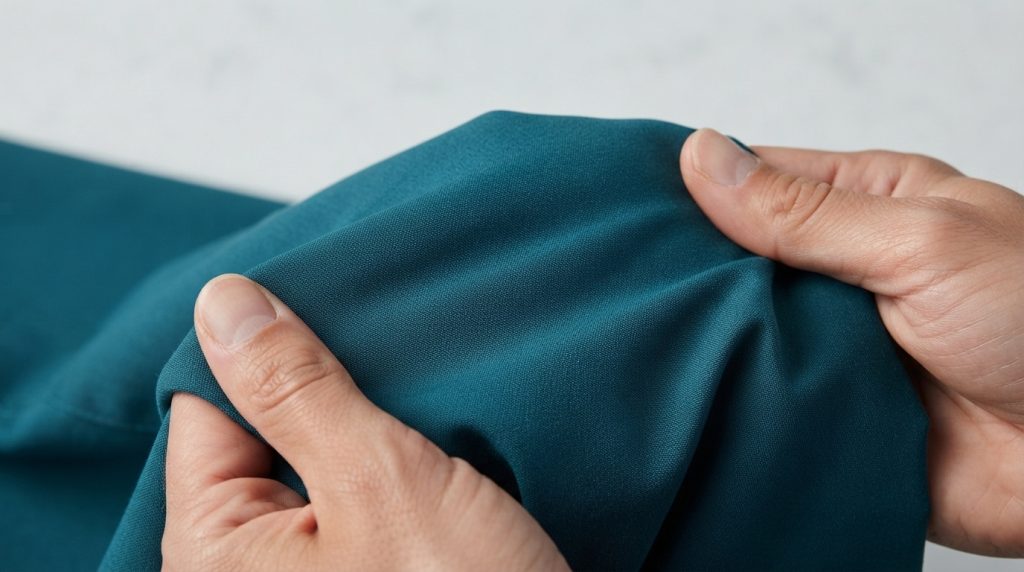
Stretch helps with repeated movement
Stretch fabric is especially useful for professionals who frequently:
- Bend at the waist
- Reach overhead
- Squat
- Sit and stand repeatedly
- Move between examination rooms
- Assist with positioning or mobility tasks
A fabric does not need to feel extremely elastic to provide useful mobility. In many cases, modest mechanical stretch or a blended fabric with a stretch fiber can help the garment move with the body.
When assessing stretch, pull the fabric gently and observe how quickly it returns to its original shape. A scrub top or pant that stretches but remains baggy afterward may require frequent adjustment during a shift.
Lightweight fabric can reduce the feeling of bulk
Heavy fabric may feel substantial, but added weight is not always an advantage in an active healthcare environment.
Lightweight scrub fabrics can be preferable for professionals who:
- Walk extensively
- Work in warm departments
- Wear layers
- Use protective equipment over clothing
- Prefer less fabric weight during long shifts
NIOSH has also discussed the physiological burden that healthcare workers can experience during prolonged PPE use, particularly in physically demanding conditions. Scrub fabric cannot remove that burden, but choosing appropriate base workwear can help avoid unnecessary layering bulk.
Breathability and moisture comfort are different considerations
“Breathable” is often used broadly in apparel descriptions. When evaluating scrubs, consider how the garment actually feels during movement and in warm conditions.
Ask:
- Does the fabric feel dense or light?
- Does air move through it reasonably well?
- Does it cling when the wearer becomes warm?
- How quickly does it feel comfortable again after active tasks?
A fabric can offer stretch without feeling particularly light. Another fabric may feel airy but have less recovery. Choosing between them depends on the work environment.
Softness should be evaluated after movement
A soft fabric can feel pleasant against the skin, but softness alone does not determine long-shift performance.
Move the arms forward, rotate the shoulders, sit down, and bend the knees. Pay attention to friction at:
- The neckline
- Underarms
- Inner thighs
- Waistband
- Behind the knees
Healthcare professionals who are ready to buy medical scrubs online should review fabric descriptions together with garment cut, pocket design, and sizing information rather than choosing by fabric name alone.
How should scrub tops fit for a long healthcare shift?
A good scrub top should stay professional while allowing the upper body to move naturally.
The shoulder seam, chest width, sleeve opening, and overall length can all affect mobility.
Check shoulder and upper-back movement
Reach both arms forward as though adjusting equipment or assisting with a task.
Then raise the arms and reach across the body.
A scrub top may be too restrictive if it:
- Pulls strongly across the upper back
- Cuts into the underarm
- Forces the neckline upward
- Requires constant readjustment after reaching
A top that is too large can create different problems. Excess fabric may bunch, shift, or interfere with access to pockets.
The goal is functional room rather than simply choosing a larger size.
Consider scrub top length
Top length affects coverage and movement.
A very short top may rise excessively when reaching or bending. An excessively long top may bunch at the hips or interfere with pant pockets.
Professionals exploring women’s medical scrubs should consider how shaped seams, side vents, tuckable cuts, and traditional straight fits interact with their movement preferences.
Neckline shape affects both comfort and coverage
V-neck, round-neck, mock-wrap, notched-neck, and other scrub top designs can fit differently when bending forward.
Before choosing a neckline, simulate normal work positions.
Check coverage while:
- Leaning over a desk
- Reaching toward the floor
- Sitting
- Bending forward
A neckline that looks correct while standing upright may behave differently during active work.
How should scrub pants fit for all-day comfort?
Scrub pants often create the most noticeable long-shift fit problems because the waist, hips, thighs, knees, and inseam all need to work together.
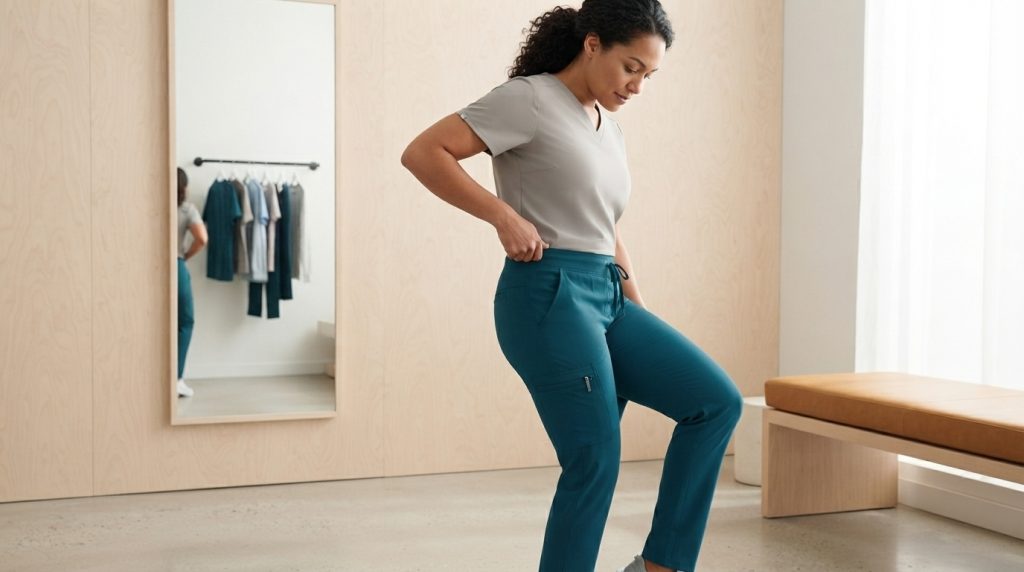
The waistband should feel secure without excessive pressure
A waistband must hold the scrub pant in place through repeated movement.
Common designs include:
- Full elastic waistbands
- Drawstring waistbands
- Knit waist panels
- Yoga-style waistbands
- Hybrid elastic and drawstring systems
The best option depends on personal preference and body shape.
Sit for several minutes when trying on scrub pants. A waistband that feels acceptable while standing may create pressure when seated.
Then stand and walk. If the pants immediately begin slipping, the waistband or rise may not be the right match.
Rise affects how scrub pants move
Rise refers to the relationship between the waistband and crotch area.
A rise that is too short may pull during sitting or bending. A rise that is too long may create excess fabric and bunching.
Mid-rise styles work well for many wearers, but the label itself is not enough. Body proportions differ, so actual fit should guide the decision.
Leg shape changes both appearance and function
Common scrub pant cuts include:
Jogger pants
Joggers taper toward the ankle and usually include a cuff or narrow opening. They can reduce loose fabric around the lower leg.
Tapered pants
Tapered scrub pants gradually narrow toward the ankle without necessarily using a jogger cuff.
Straight-leg pants
Straight-leg styles maintain a more consistent width through the leg and provide a traditional professional appearance.
Cargo scrub pants
Cargo styles emphasize storage, often including additional thigh pockets.
Flare or bootcut scrub pants
These styles widen toward the lower leg and may appeal to professionals who prefer a less tapered silhouette.
No cut is automatically the most comfortable. The right style depends on movement, footwear, storage needs, and personal fit.
How much stretch do medical scrubs really need?
More stretch is not always better.
Scrubs need enough flexibility to support movement, but excessive elasticity can sometimes create a very soft, body-following fit that not every professional prefers.
A useful test is to perform several movements while wearing the scrub set:
- Sit fully in a chair.
- Reach both arms forward.
- Squat or bend carefully.
- Raise one knee.
- Walk quickly.
- Reach above shoulder level.
The garment should move without creating strong pulling at major tension points.
Healthcare workers involved in patient movement also face broader ergonomic demands. OSHA identifies repeated patient handling, lifting, repositioning, and awkward postures as major contributors to musculoskeletal injury in healthcare. Proper safe-patient-handling systems remain essential and should not be replaced by clothing choices.
Scrub stretch is simply a clothing comfort consideration within that larger work environment.
How many pockets should scrubs have?
The correct number of pockets depends on what the wearer actually carries.
More pockets can be useful, but extra storage often leads people to carry more items. Loaded pockets can pull the garment out of position and create uneven weight.
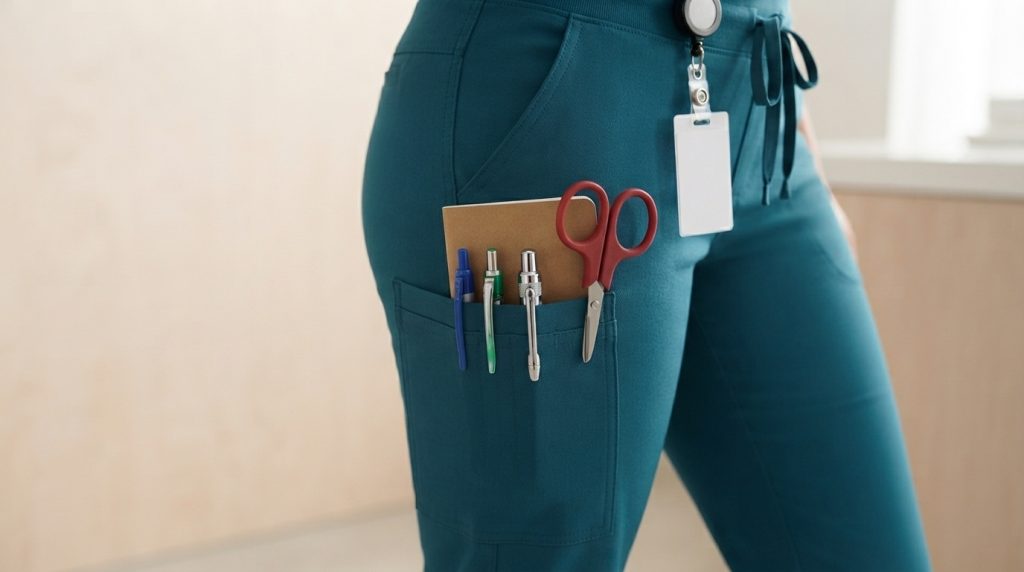
Start with a pocket inventory
Before buying scrubs, list what is routinely carried.
Possible items include:
- Pens
- Small notebook
- Badge-related items
- Scissors
- Penlight
- Personal phone
- Work communication device
- Small clinical accessories permitted by the facility
Then decide where each item should sit.
Chest pockets
Chest pockets provide quick access to lightweight objects. Heavy items may cause a scrub top to pull forward.
Front patch pockets
Large lower pockets are useful for general storage and can distribute items across the front of the garment.
Cargo pockets
Cargo pockets can provide additional storage along the thigh. They are especially useful when shirt-pocket space is limited.
However, bulky items can swing or press against the leg during walking.
Zippered pockets
A zippered pocket may be useful for securing a key, small personal item, or other object that should not fall out easily.
The best pocket system is the one that supports the wearer’s real routine without turning the scrub uniform into overloaded storage.
Should men and women choose scrubs differently?
The basic performance requirements remain similar: movement, storage, temperature comfort, fit, and durability.
However, garment construction and body proportions can affect how different cuts perform.
For example, men’s scrubs may use different shoulder widths, torso proportions, pant rises, and leg cuts than women’s styles.
The most important rule is to evaluate the actual garment rather than assuming that a label guarantees fit.
A healthcare professional should check:
- Shoulder width
- Chest room
- Hip fit
- Thigh room
- Rise
- Inseam
- Sleeve opening
- Top length
Unisex sizing can also vary considerably by manufacturer and collection. Review the specific size chart whenever changing styles or brands.
Why does inseam length matter during long shifts?
Incorrect pant length creates more than an appearance issue.
Scrub pants that are too long may drag, collect dirt, or bunch around footwear. Pants that are too short may pull upward excessively when sitting.
Length options commonly include:
- Petite
- Short
- Regular
- Tall
The exact inseam represented by each label can vary.
Measure a well-fitting pair of work pants from the crotch seam to the lower hem and compare that measurement with the scrub size information.
Also consider footwear. A pant length that works with one shoe may sit differently with another.
Are expensive scrubs always better for long shifts?
No. Price alone does not determine comfort.
Higher-priced scrubs may include specialized fabric blends, detailed construction, more complex pocket systems, or refined finishes. However, an affordable scrub set that fits the wearer correctly may perform better than an expensive set with the wrong rise, inseam, or cut.
Evaluate value based on:
- Fit
- Fabric recovery
- Pocket usefulness
- Seam comfort
- Wash requirements
- Color retention expectations
- Frequency of wear
- Cost per wear
Healthcare professionals who rotate through several sets each week may value easy care and consistency. Others may prioritize a particular fabric feel or highly specific pocket configuration.
The best scrub is the one that matches the wearer’s work requirements and remains usable over repeated wear.
How should scrubs be tested before a long shift?
Never judge workwear only by standing in front of a mirror.
Use a simple movement test.
The five-minute scrub fit test
Wear the complete scrub set with normal work underlayers and, when practical, typical work shoes.
Then:
- Walk around.
- Sit for at least one minute.
- Reach overhead.
- Reach forward.
- Bend carefully.
- Place normal lightweight items in the pockets.
- Check the waistband again.
- Raise the arms and check top coverage.
Look for pulling, slipping, bunching, exposed areas, and pressure points.
For shoppers who prefer to test different fits in person, visiting a local scrub store in Lincoln can make it easier to compare cuts, inseams, and fabric feel before choosing workwear.
How should medical scrubs be cared for?
Always follow the garment care label and workplace policy.
Healthcare textiles can be subject to facility-specific handling requirements, particularly when contamination is involved. CDC guidance on laundry and bedding in healthcare settings discusses uniforms and scrub suits within healthcare textile management and notes that facilities may have their own policies and cleaning guidance.
For routine garment care:
- Read the care label before the first wash.
- Separate colors when recommended.
- Avoid using excessive heat when the fabric instructions advise lower temperatures.
- Empty every pocket before washing.
- Close zippers when directed by the garment manufacturer.
- Inspect seams and waistbands regularly.
- Replace workwear that no longer fits securely or remains in acceptable condition.
Do not assume that every scrub fabric can be washed or dried using the same settings.
What is the best way to build a long-shift scrub rotation?
A practical work wardrobe should reduce daily decision-making.
Start by identifying:
- Required workplace colors
- Preferred scrub top cut
- Preferred pant rise
- Correct inseam
- Essential pocket layout
- Preferred fabric weight
Once a reliable combination is found, consider building a rotation around several compatible sets.
Some professionals prefer matching tops and pants from the same collection. Others mix compatible garments based on fit.
Consistency can make reordering easier, but it is still wise to check sizing when a style changes or when trying a different collection.
Final thoughts
Choosing medical scrubs for long shifts is primarily a fit and function decision.
Start with the movement demands of the job. Then compare fabric weight, stretch, scrub top mobility, waistband construction, rise, inseam, and pocket placement.
The best-looking scrub set will not feel practical if the shoulders pull every time the wearer reaches forward or the waistband requires adjustment throughout the day.
A better approach is simple: choose scrubs the way professional work equipment is evaluated, by considering the actual tasks, environment, and hours in which the garment will be used.
Frequently Asked Questions
The most comfortable scrubs generally provide enough stretch for movement, a secure waistband, proper inseam length, and fabric suited to the work environment. Comfort is highly dependent on individual body proportions and job duties, so fit should be tested while sitting, bending, reaching, and walking.
Stretch can help nurses move during bending, reaching, and repeated changes in position. However, the fabric should also recover its shape. Highly stretchy scrubs are not automatically better if they become loose, sag, or fail to provide the structured fit the wearer prefers.
Joggers can be comfortable for long shifts when the rise, waistband, thigh room, and cuff fit correctly. Some professionals prefer the reduced fabric around the ankle, while others prefer straight or tapered scrub pants. The best choice depends on movement and personal fit.
The ideal number depends on weekly work frequency, laundry schedule, workplace uniform rules, and the need for backup clothing. A practical rotation should provide enough clean sets for scheduled shifts while allowing time for proper laundering and garment inspection.
Scrubs should generally provide functional room without excessive loose fabric. Tight scrubs may restrict movement, while oversized garments can shift, bunch, or create impractical excess material. The correct fit allows sitting, reaching, walking, and bending without strong pulling or repeated adjustment.
Review the size chart, garment measurements, fabric composition, stretch description, rise, inseam, pocket layout, and care instructions. Compare those details with a scrub set that already fits well rather than relying only on the usual letter size.