

The best scrub pant waistband depends on how the wearer prefers pressure, support, adjustability, and movement around the waist. Yoga waistbands typically provide a broad, flexible fit, full elastic waistbands offer consistent stretch around the waist, and half-elastic designs combine elasticized sections with more structured areas.
Healthcare professionals comparing Edge scrub pants can currently find women’s yoga-waist and elastic-waist styles as well as a men’s half-elastic waistband pant within the collection. The best choice is not determined by waistband type alone. Rise, fabric stretch, body proportions, pant silhouette, pocket weight, and the amount of sitting, walking, bending, and reaching performed during work all affect comfort.
Quick Answer
Choose a scrub pant waistband according to how it feels during real work movements:
- Yoga waist: Often suits wearers who prefer a broad, flexible waistband with pressure distributed across a wider area.
- Full elastic waist: Provides stretch around most or all of the waist and can be simple to pull on and adjust through movement.
- Half-elastic waist: Combines elastic flexibility with a more structured section and may appeal to wearers who want support without full elastic construction.
- Drawstring combinations: Can provide additional adjustability when included with elastic.
- Rise matters: Even a comfortable waistband may feel wrong if the pant rise does not suit the wearer’s proportions.
- Fabric matters: Stretch, recovery, weight, and drape influence how the waistband interacts with the rest of the pant.
- Movement testing matters most: Sit, bend, walk, take a long step, and perform a shallow squat before deciding.
There is no universally best scrub waistband. The right option is the one that stays secure and comfortable without creating excessive pressure, rolling, slipping, or requiring repeated adjustment.
Why does scrub pant waistband design matter?
A scrub pant waistband sits at one of the body’s major movement areas.
Throughout a healthcare workday, the wearer may repeatedly move between:
- Standing
- Sitting
- Walking
- Bending
- Reaching
- Squatting
- Turning
- Moving from sitting to standing
Each of these movements changes the relationship between the waist, hips, abdomen, and garment.
A waistband that feels comfortable while standing may create pressure while sitting.
A design that feels secure during a short fitting may start slipping after repeated walking.
This is why waistband fit should be evaluated dynamically.
Small waistband problems can become noticeable over time
A minor fit issue can become distracting when it happens repeatedly.
Examples include:
- Rolling at the top edge
- Sliding downward
- Tightening while seated
- Twisting
- Creating pressure around the abdomen
- Requiring repeated drawstring adjustment
The most comfortable waistband is usually the one the wearer notices the least during work.
What is a yoga waistband on scrub pants?
A yoga-style waistband generally uses a broad, flexible band around the waist.
Compared with a narrower elastic band, the wider construction may spread contact across a larger area.
This can create a softer or less concentrated feeling for some wearers.
Women’s scrub assortments currently include yoga-waist designs, including an Edge women’s yoga waist pant.
Why do some healthcare professionals prefer yoga waistbands?
A yoga waistband may appeal to wearers who:
- Prefer a broad waistband
- Dislike narrow elastic pressure
- Want a flexible pull-on fit
- Spend substantial time sitting
- Move frequently between positions
The construction may feel more similar to performance or athletic apparel than a traditional work pant waistband.
Yoga waist does not automatically mean loose
A broad waistband can still fit securely.
The important issue is whether the waistband tension suits the wearer.
A waistband that is too large may slide.
One that is too small may feel compressed.
The correct size remains important.
How should a yoga waistband fit?
A yoga waistband should generally sit smoothly around the waist without requiring constant adjustment.
Test it while standing
Stand naturally.
Check whether the waistband:
- Lies relatively flat
- Feels secure
- Creates obvious pressure
- Rolls at the top
Test it while sitting
Sit for several minutes.
This is particularly important because abdominal and hip positions change in a seated posture.
Ask:
- Does the waistband dig in?
- Does it fold over?
- Does it remain comfortable?
- Does the pant rise feel appropriate?
Test it during bending
Bend slightly at the knees and hips.
The waistband should remain stable enough that the wearer does not need to repeatedly pull the pants back into position.
What is a full elastic waistband?
A full elastic waistband typically uses elastic around most or all of the waist.
It provides flexible expansion and can create a straightforward pull-on pant design.
Women’s scrub categories currently include an Edge women’s elastic waist pant.
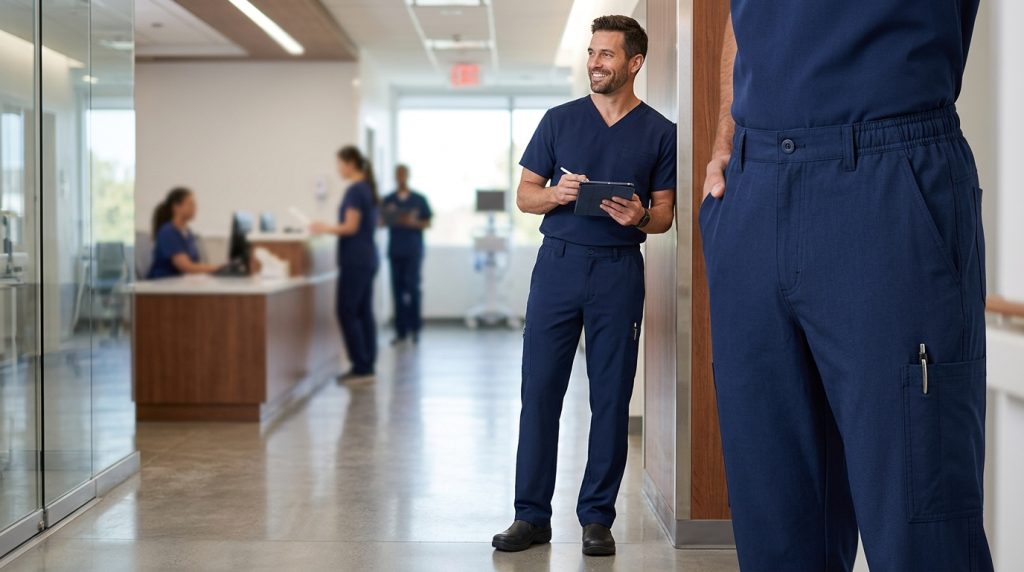
Why choose full elastic scrub pants?
Full elastic construction may suit healthcare professionals who prefer:
- Easy pull-on dressing
- Consistent stretch around the waist
- Simple waistband construction
- Flexible fit during movement
The waistband can adapt as the body moves between standing and sitting.
However, comfort depends on elastic tension.
Elastic tension matters
A full elastic waistband should not be evaluated simply by whether it stretches.
The important questions are:
- How much pressure does it create?
- Does it remain secure?
- Does it recover after stretching?
- Does it roll?
- Does it twist?
The best elastic waistband provides flexibility without feeling unstable or overly tight.
What is a half-elastic waistband?
A half-elastic waistband typically combines an elasticized section with a more structured section.

The elastic may be concentrated around the back or another portion of the waist, depending on the garment design.
Current men’s scrub pants include an Edge men’s half-elastic waistband pant in addition to a men’s jogger option.
Why might someone prefer half-elastic construction?
Half-elastic designs may appeal to wearers who want:
- Some waistband flexibility
- A more structured front or waistband section
- A traditional workwear appearance
- Less elasticized fabric around the entire waist
This can create a different feel from a yoga waist or full elastic design.
Structured does not automatically mean restrictive
A half-elastic waistband can still move comfortably when properly sized.
The elastic portion provides flexibility while the structured area influences how the pants sit.
The wearer should test the pant while both standing and sitting.
Yoga waist vs elastic waist: what’s the difference?
Both designs can provide flexibility, but they distribute that flexibility differently.
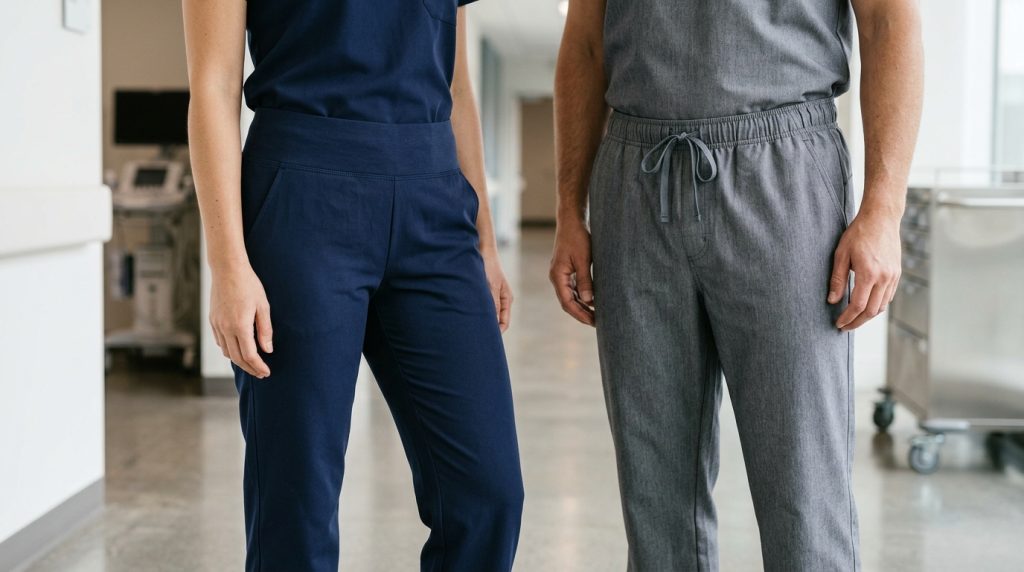
Yoga waist
Usually:
- Broader
- Softer in appearance
- Athletic-inspired
- Designed to spread waistband contact over a wider area
Full elastic waist
Usually:
- Relies more directly on elastic tension
- Creates consistent stretch around the waist
- Often has a simpler pull-on structure
Neither is universally more comfortable.
A wearer who dislikes concentrated elastic pressure may prefer a yoga-style band.
Someone who wants a straightforward, secure pull-on waist may prefer full elastic.
The only reliable way to decide is to try both during sitting and movement.
Full elastic vs half elastic: what’s the difference?
The primary difference is how much of the waistband relies on elastic.
Full elastic
Elastic runs around most or all of the waistband.
This allows flexibility around the entire waist.
Half elastic
Only part of the waistband is elasticized.
The remainder is more structured.
This can create a different balance between:
- Flexibility
- Stability
- Appearance
- Adjustment
Healthcare professionals who prefer a more traditional pant structure may find half-elastic construction appealing.
Which waistband is best for long shifts?
There is no universal answer.
Long-shift comfort depends on more than the waistband.
Important factors include:
- Pant rise
- Fabric stretch
- Fabric weight
- Hip fit
- Thigh room
- Sitting time
- Activity level
- Pocket weight
Consider how much time is spent sitting
Someone who remains seated for substantial periods may pay more attention to how the waistband feels when the abdomen and hips are flexed.
A yoga waistband may appeal to some seated workers because of its broad construction.
However, another wearer may prefer the security of traditional elastic.
Consider how much walking is required
Healthcare professionals who walk continuously should check whether the waistband remains secure.
A waistband that feels comfortable but gradually slips may become frustrating.
Consider repeated bending
Bending can cause waistbands to shift.
The wearer should test whether the pants remain reasonably stable during forward movement.
How does pant rise affect waistband comfort?
Rise is one of the most overlooked factors in scrub pant fit.
It describes how the pants sit between the crotch and waistband.
A waistband can be well designed but still feel uncomfortable if the rise does not suit the wearer’s body.
Rise affects sitting
When sitting, the relationship between the waistband, hips, and torso changes.
A rise that feels too short may create:
- Pulling
- Waistband movement
- Pressure
A rise that feels too long may create:
- Excess fabric
- Bunching
- An unstable waistband position
The waistband and rise should therefore be evaluated together.
Does body shape affect which waistband works best?
Yes.
People with different waist-to-hip proportions may experience the same waistband differently.
One wearer may need more flexibility at the waist.
Another may need a more structured waistband to keep the pants secure.
A third may prefer a broad yoga band because of how it distributes pressure.
There is no body type that must use one specific waistband.
Focus on fit behavior rather than labels
Instead of asking:
“Which waistband is best for my body type?”
a more useful question is:
“Which waistband stays comfortable and secure on my body while I sit, bend, walk, and work?”
This approach avoids forcing every wearer into a predetermined style.
How does scrub fabric change waistband comfort?
Waistbands do not function independently from the rest of the garment.
The pant fabric can influence:
- Flexibility
- Drape
- Weight
- Recovery
- Hip movement
A lightweight stretch fabric may create a different experience from a more rigid textile.
The current Edge collection is built around a lightweight polyester-rayon-spandex blend and includes multiple waistband and pant constructions.
Stretch through the hips matters
When sitting or bending, fabric around the hips and upper thighs must move.
If the pant body is too restrictive, a comfortable waistband alone will not solve the problem.
Fabric recovery matters
Recovery describes how the textile returns toward its previous shape after stretching.
Repeated sitting, bending, and walking can place tension around the waist and hips.
A performance pant should therefore be evaluated after repeated movement.
How should women’s scrub pants be evaluated?
Women’s scrub categories often contain a wide range of silhouettes and waistband constructions.
Current women’s scrub pants include yoga-waist, elastic-waist, jogger, tapered, flare, and other styles across several collections.
This provides an important reminder:
Waistband style and leg silhouette are separate decisions.
A wearer may prefer:
- Yoga waist + straight or tapered leg
- Yoga waist + flare
- Elastic waist + traditional leg
- Drawstring + jogger
The best combination depends on the complete fit.
How should men’s scrub pants be evaluated?
Men’s scrub pants should be evaluated across:
- Waist
- Rise
- Hips
- Thighs
- Knees
- Calves
- Inseam
Current men’s options include both half-elastic and jogger pant constructions within the Edge collection.
Thigh fit can affect waistband comfort
If the thighs are too tight, walking or sitting can pull the entire pant downward.
The wearer may incorrectly assume the waistband is the problem.
In reality, the lower portion of the garment may be creating tension.
This is why men’s scrub pants should be assessed as complete garments rather than by waistband alone.
Which waistband works best for nurses?
Nurses may repeatedly sit, walk, bend, and assist with patient movement.
NIOSH notes that healthcare workers can face significant physical demands, particularly during patient handling, and recommends workplace strategies such as safe patient-handling programs and assistive devices to reduce musculoskeletal risk.
Scrub pants do not prevent musculoskeletal injuries or replace ergonomic controls, but clothing should avoid adding unnecessary restriction.
Nurses who walk frequently
They may prioritize:
- Waistband security
- Hip mobility
- Stretch
- Pocket stability
Nurses who sit frequently
They may pay more attention to:
- Waist pressure
- Rise
- Waistband width
Nurses with mixed duties
A waistband should function reasonably well across both standing and seated tasks.
There is no one nurse-specific waistband that works for everyone.
Which waistband works best for doctors?
Doctors work in varied environments.
A physician in an outpatient practice may spend substantial time moving between consultations and seated documentation.
Another may work in a hospital or procedural setting with greater physical movement.
Possible priorities include:
- Professional appearance
- Sitting comfort
- Secure waist fit
- Pocket accessibility
- Easy movement
Some doctors may prefer half-elastic construction because of its more structured appearance.
Others may prefer yoga or full elastic designs for comfort.
Workplace requirements should guide the final decision.
Which waistband works best for dental professionals?
Dental professionals often spend prolonged periods seated or leaning toward patients.
This makes seated waistband testing especially important.
They should evaluate:
- Pressure around the waist
- Rise comfort
- Hip tension
- Whether the waistband rolls
- Whether the pants shift during leaning
A broad yoga waistband may appeal to some wearers.
However, full or half elastic can also work well when properly fitted.
The garment must be judged in a realistic seated posture.
Which waistband works best for veterinary professionals?
Veterinary professionals may:
- Crouch
- Kneel
- Bend
- Reach
- Move quickly around animals
Waistband stability becomes particularly important.
A pant that slips during crouching may require repeated adjustment.
Veterinary workers should test:
- A shallow squat
- A controlled crouch
- A long step
- Sitting
- Standing again
The pants should stay secure through the sequence.
Do drawstrings make elastic waistbands better?
They can provide additional adjustability.
Some scrub pants combine elastic with a drawstring so the wearer can fine-tune waist tension.
This can be useful when:
- The wearer falls between sizes
- The waistband needs additional security
- Pocket contents add weight
However, drawstrings can also create their own comfort issues.
Test the drawstring while sitting
A tightly tied knot may press against the abdomen when seated.
The wearer should check:
- Knot position
- Drawstring pressure
- Whether it remains tied
- Whether constant readjustment is required
A drawstring is useful when it improves fit, not simply because it adds another feature.
Can pockets affect waistband comfort?
Yes.
Pocket weight can influence how scrub pants sit.
A heavily loaded side or cargo pocket may pull the pants downward on one side.
This can make the waistband feel less secure.
Consider what is actually carried
Possible work items may include:
- Pens
- Small notes
- Identification items
- Communication devices
- Approved tools
The correct storage arrangement depends on the role.
Test realistic pocket weight
If appropriate during a fitting, place representative lightweight items in the intended pockets.
Then:
- Walk
- Sit
- Bend
Check whether the waistband shifts.
This can reveal fit problems that are not noticeable when the pockets are empty.
Can waistband width affect comfort?
Yes.
A wider waistband spreads contact across a broader area.
A narrower band concentrates pressure into a smaller area.
Neither is universally more comfortable.
Some wearers prefer the broader feel of a yoga waist.
Others prefer the simplicity and security of traditional elastic.
Personal sensitivity, body proportions, and sitting habits all affect the preference.
Can scrub waistbands roll?
Any flexible waistband may potentially roll or fold depending on:
- Fit
- Body movement
- Band width
- Garment construction
- Body proportions
A waistband that repeatedly rolls may indicate:
- The size is unsuitable
- The rise is incorrect
- The construction does not suit the wearer
Trying another size or waistband type may help.
Should scrub pants feel tight at the waist?
Scrub pants should generally feel secure rather than constrictive.
A waistband should not require excessive tightness to keep the garment in position.
Signs that the waist may be too tight include:
- Pressure while sitting
- Deep garment marks
- Repeated discomfort
- Difficulty bending naturally
However, a waistband that is too loose may:
- Slide down
- Twist
- Require frequent pulling up
The correct fit is a balance between security and comfort.
What does ergonomics have to do with scrub pant selection?
Ergonomics is primarily about designing work tasks and environments to suit workers’ capabilities, not selecting clothing. NIOSH describes ergonomics as fitting work tasks and job demands to workers and notes that physical demands and awkward postures are among workplace risk factors for musculoskeletal disorders.
Scrub pants should therefore not be presented as injury-prevention equipment.
However, workwear should allow the wearer to perform required movements without unnecessary garment restriction.
The distinction is important:
Good waistband fit supports clothing comfort.
Ergonomic workplace design addresses occupational risk.
The two should not be confused.
Are scrub pants considered PPE?
Ordinary medical scrub pants are workwear, not automatically personal protective equipment.
OSHA’s ergonomics guidance emphasizes workplace design and controls for reducing physical strain rather than ordinary clothing as a safety intervention.
Where protective clothing is required for a particular hazard, workers should follow employer procedures and applicable PPE requirements.
A comfortable waistband does not replace:
- Protective gowns
- Required barrier clothing
- Safe patient handling equipment
- Other hazard controls
How should scrub pants be tested before buying?
A structured fit test can make waistband differences much easier to compare.
Supporting Image #3 Download here
ALT: Healthcare professional testing scrub waistband comfort while sitting and bending
Step 1: Stand normally
Check:
- Waist position
- Rise
- Hip fit
- Overall pant length
Step 2: Sit for several minutes
Notice:
- Pressure
- Rolling
- Sliding
- Rise comfort
Step 3: Stand again
Check whether the waistband has shifted.
Step 4: Take a long step
This tests hip and thigh mobility.
Step 5: Bend the knees
Notice whether the pant body pulls on the waistband.
Step 6: Perform a shallow squat
The pants should remain reasonably secure.
Step 7: Walk
Check for slipping or twisting.
Step 8: Test pockets
Add representative lightweight work items where appropriate.
The waistband should continue to function.
Which scrub waistband should you choose?
A simple decision framework can help.
Choose a yoga waistband if:
- You prefer a broad waist construction.
- You dislike narrow elastic pressure.
- You want an athletic-inspired feel.
- The waistband remains secure during movement.
Choose a full elastic waistband if:
- You prefer flexible pull-on construction.
- You want stretch around the full waist.
- The elastic tension feels comfortable.
- You value simple dressing.
Choose a half-elastic waistband if:
- You want some elastic flexibility.
- You prefer a more structured portion of the waistband.
- A traditional workwear appearance appeals to you.
- The structured area remains comfortable while sitting.
These recommendations are starting points.
The actual garment should always be tested.
A Practical Scrub Waistband Checklist
Before selecting scrub pants, evaluate the following.
Standing Fit
- Does the waistband feel secure?
- Does it sit where expected?
- Is there excessive pressure?
- Does it lie reasonably flat?
Sitting Comfort
- Does the waistband dig in?
- Does it roll?
- Does the rise remain comfortable?
- Does the pant require adjustment?
Movement
- Can you bend comfortably?
- Can you take a long step?
- Can you squat slightly?
- Does the waistband slide?
Fabric
- Is there adequate stretch?
- Does the fabric recover after movement?
- Is the fabric weight appropriate?
- Does the drape suit the silhouette?
Pant Fit
- Is there enough hip room?
- Are the thighs comfortable?
- Can the knees bend?
- Is the inseam correct?
Pockets
- Are they accessible?
- Does pocket loading pull the waistband?
- Are stored items secure?
Workplace Needs
- Is the style allowed?
- Does the color meet policy?
- Does the pant suit the actual work routine?
Final Thoughts
Yoga waist, full elastic, and half-elastic scrub pants can all provide comfortable, professional workwear when the garment is properly fitted.
The main differences involve how flexibility and support are distributed around the waist.
A yoga waistband provides a broad flexible band. Full elastic distributes stretch around most or all of the waist. Half-elastic construction combines flexible and structured areas.
But waistband type should never be evaluated alone.
Rise, hip room, thigh fit, stretch, fabric recovery, pant silhouette, pockets, and work movements can all change how the waistband feels during the day.
The strongest choice is the scrub pant that stays secure, comfortable, and relatively unnoticed while the wearer sits, walks, bends, reaches, and works.
Frequently Asked Questions
Is a yoga waistband better than an elastic waistband for scrubs?
Not universally. A yoga waistband provides a broad flexible fit, while a traditional elastic waistband relies more directly on elastic tension. Some wearers prefer the wider yoga construction, while others prefer the secure feel of full elastic.
What is a half-elastic waistband on scrub pants?
A half-elastic waistband combines an elasticized portion with a more structured section. This provides some flexibility without using elastic around the entire waist and may create a more traditional workwear fit.
Which scrub waistband is most comfortable for long shifts?
The most comfortable waistband depends on rise, body proportions, sitting time, movement, and personal preference. Yoga, full elastic, and half-elastic designs can all work well when properly fitted.
Are yoga waist scrub pants good for sitting?
They can be. The broad flexible waistband may feel comfortable to some people during seated work, but the rise and waistband tension must still suit the wearer. Always test scrub pants while seated before choosing them.
Why do scrub pant waistbands roll down?
Rolling can result from waistband construction, sizing, body proportions, movement, or an unsuitable pant rise. Trying another size or waistband style may provide a more stable fit.
Should scrub pants have a drawstring and elastic?
A combination can provide both flexibility and adjustability, but it is not necessary for every wearer. The best design is the one that remains secure and comfortable without requiring repeated adjustment.